




Generational Decay
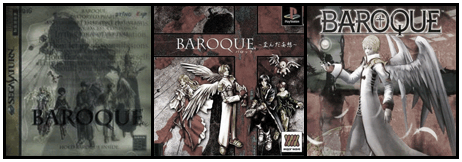
Baroque has had three major releases: "Baroque" for the Sega Saturn in 1998, "Baroque ~Distorted Delusions~" for the Sony Playstation in 1999, and "Baroque International" for the Sony Playstation 2 and Nintendo Wii in 2007/2008. The port and remake are often assumed to be the definitive versions, but this is a misconception based on the relative obscurity of the original Sega Saturn title.
The PS1 Port
The initial port of the game, "Baroque ~Distorted Delusions~" was released in the year following the original. Whether the development team wasn’t given enough time to fully convert all of the code over from the Saturn’s esoteric architecture or they were simply exhausted from years of painstaking work on the original, the port ended up being a weaker experience than its Sega Saturn progenitor in several ways.
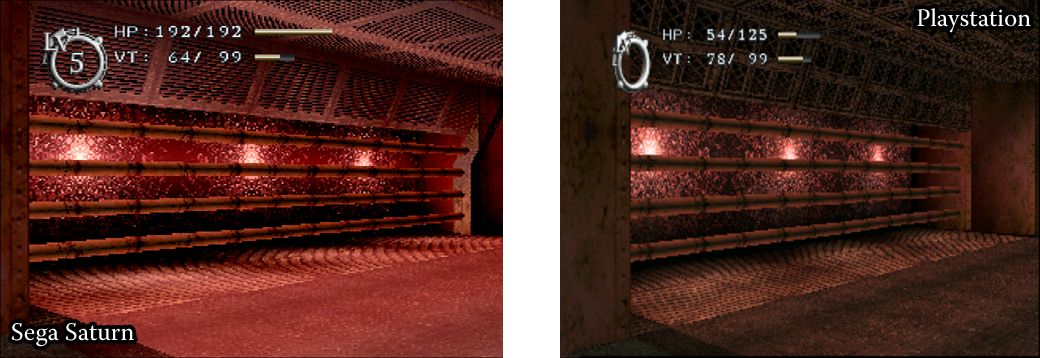
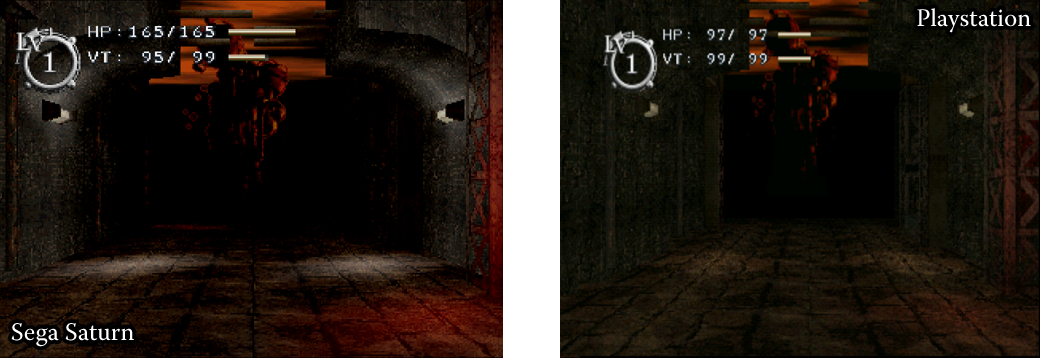
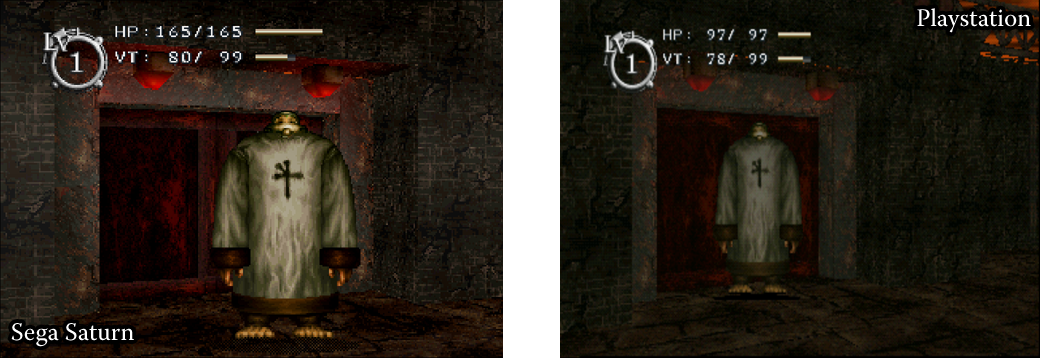
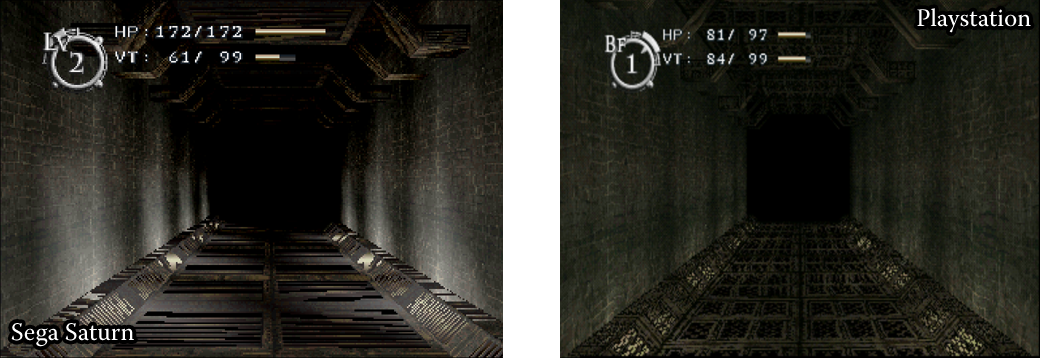
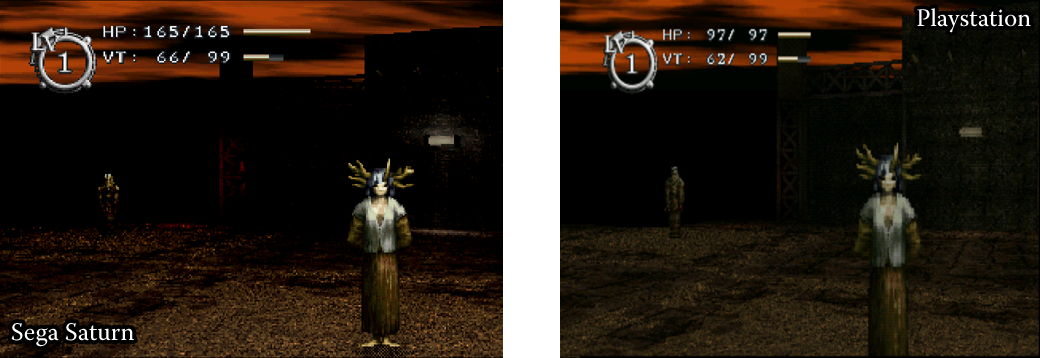
A striking change found in the Playstation version is the dilution of the film noir aesthetic the original game was conceived around. Instead of stark contrast, heavy use of shadows, and bold lighting, the PS1 port has more uniform, brighter lighting with little visual contrast. The heavy use of red and black in the original has been replaced by a persistent, pale green which fails to replicate the gorgeous atmospheric lighting of the Saturn version while also making level geometry pop-in more apparent. It appears the port forces the original’s widescreen setting without the option to change it back, so the sprites appear noticeably stretched out. Many details didn’t make the jump to Playstation, with small animation embellishments (such as the Hungones' swaying) being removed. Gone too are a number of sound effects and ambient noise that added variety and flavor to the soundscape of the Nerve Tower. The music transitions no longer function either, so tracks now abruptly halt at the end of each floor.
However, a couple of new features were included. There’s a post-game “Hell Dungeon” which relies heavily on artificial difficulty but can be beaten from scratch by experienced players. To better help newcomers along, a new NPC has been added to the outer world who provides long term item storage to make upgrading items and creating builds much easier. In addition to the new character, the pre-existing NPCs are often friendlier and give more hints, as well as having more dialogue and interactions. A few of these exchanges make for excellent new additions to the script, but many of the new dialogue lines amount to little more than edgy dramatics and tasteless dad jokes. The Archangel has also been rewritten to incorporate a short story written by a fan, convoluting his character and motivations.
There seems to have been a significant focus on extending the port’s runtime. The maximum depth of the Nerve Tower has been padded out, and there are several checklists available for the player to complete. Every item stored will be checked off an “Item List” and, likewise, 250 lines of arbitrarily selected dialogue with NPCs can be checked off of a “Scene List” once triggered in-game. The rewards for undertaking these tasks are concept art and promotional materials, most of which were already freely available on the Sega Saturn "Baroque Report CD Data File" promotional disc. Trying to navigate Baroque’s convoluted dialogue trees in very specific ways is an often frustrating endeavor and there are lines you have to unlock early on which are bugged, making them permanently missable. If this occurs, anyone trying to complete this list will be forced to delete all of their save data and start over again.
The PS2/Wii Remake
Aside from a few small spin-off games, the world of Baroque would go dark for almost a decade until "Baroque International" for the PS2 hit shelves in 2007, with an additional Wii release the following year. While greater accessibility provided by the new difficulty settings is a welcome addition, the remake removes numerous quality of life features from the original title which creates a long laundry list of issues that serve only to make the gameplay clunkier and less intuitive.
The expanded floor count of the PS1 port has been padded out even further, with each floor being a sprawl of intersecting hallways. While this change is thematically fitting to the chaotic nature of the Nerve Tower, it makes exploration and finding NPCs more difficult. Item usage is significantly slower in order to accommodate third person animations. Self-damage dealt by explosives has been buffed to deal a flat 40-50% of the player’s health on any difficulty level, rendering experimentation with unidentified boxes and bones no longer worth the risk. The ability to advance NPC dialogue is missing. Barricade-type enemies are unable to be targeted by bones and torturers once capable of displacing them. Several more items have lost functionality, like some Imitation Wings' ability to inflict ailments when thrown, the precision and AOE burst of Homing Bones, or Flying Torturers warping you when thrown at enemies. Flesh no longer restores a little VT and hearts no longer restore a little HP, which makes upgrading your parameters unnecessarily difficult. This list of small, pointless adjustments goes on and on, each individually inconsequential but together they create a much more rigid experience, one which discourages player freedom and creativity - a key design element of the original’s gameplay.
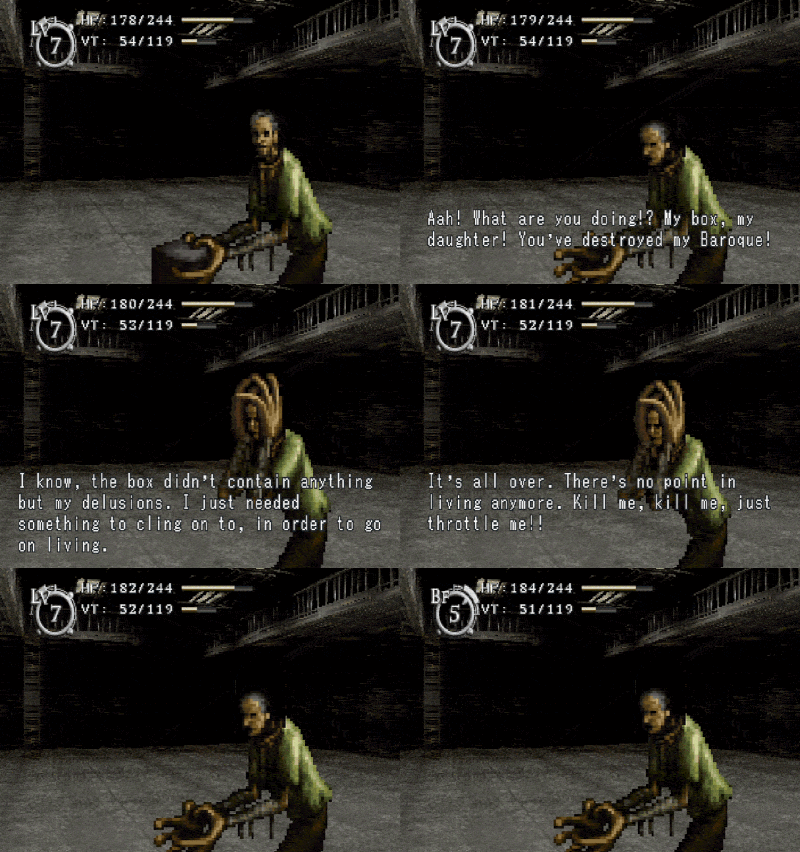
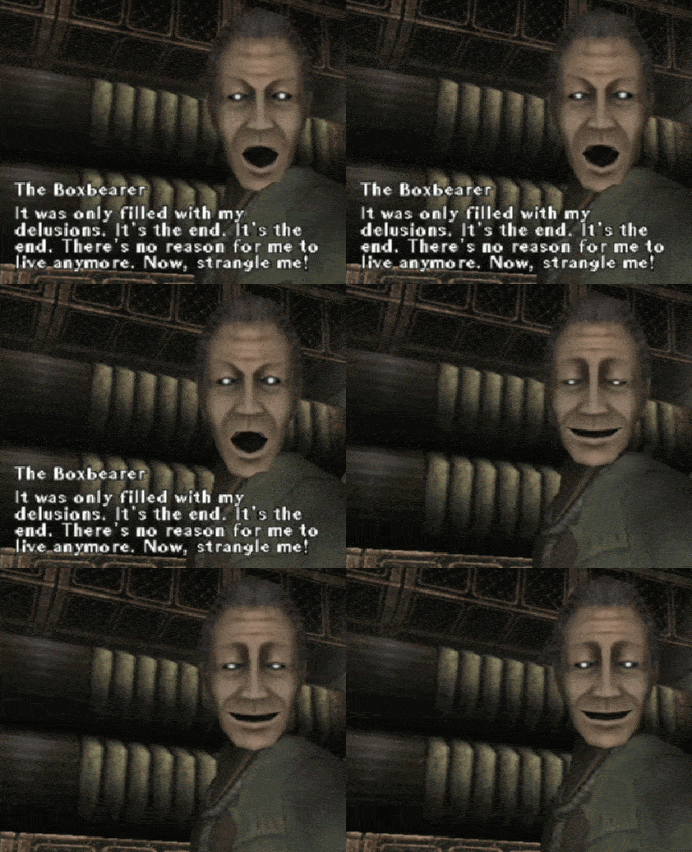
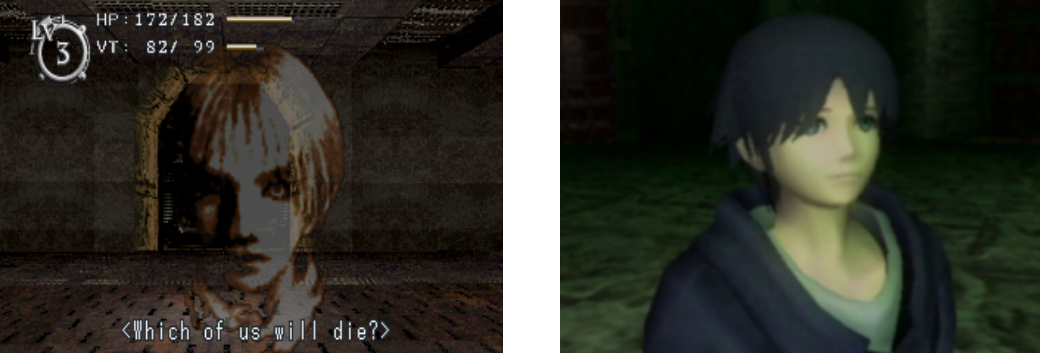
The remake does feature full 3D modeling, often giving us a much better look at Eisaku Kito’s beautiful enemy designs than the Saturn’s pre-rendered sprites ever could. Every sword, coat, and set of wings has been given a unique design and they appear on your character when playing in the new third person camera angle. This all sounds great in theory but it falters in visual execution. The character renditions and animations are unimaginative and lazy, to the point of breaking immersion and looking ridiculous during somber moments. To make things worse, the remake also features even brighter visuals and less contrast than the PS1 port had.
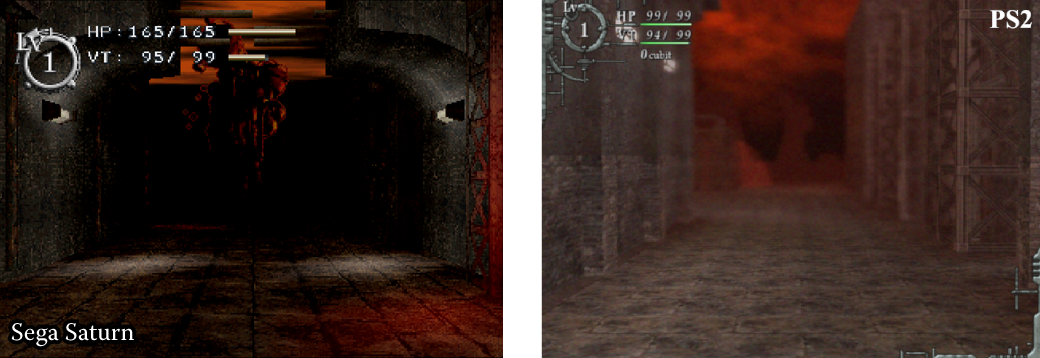
While it was never going to be a 1:1 recreation of the Saturn game, the only apparent creative vision here was to make Baroque less upsetting and more marketable. The original’s unsettling ambient soundscape - meticulously created to “not be music” - has been replaced by indistinct, unremarkable techno. Both the Japanese and English versions have had their scripts censored with many instances of the words “die” or “kill” being replaced with safer terms like “vanish” or “erase” which takes lines such as "My father tried to kill me. Are you trying to kill yourself?" and replaces them with confused dialogue like "My father tried to lay hands on me, are you trying to erase yourself?" Nudity deemed too grotesque (such as Bulger’s) has been censored, while God’s nudity (seemingly deemed appealing to the target demographic) has been played up. The post-game also allows you to 'resurrect' certain NPCs, going against their express wishes and the bittersweet nature of the original narrative.
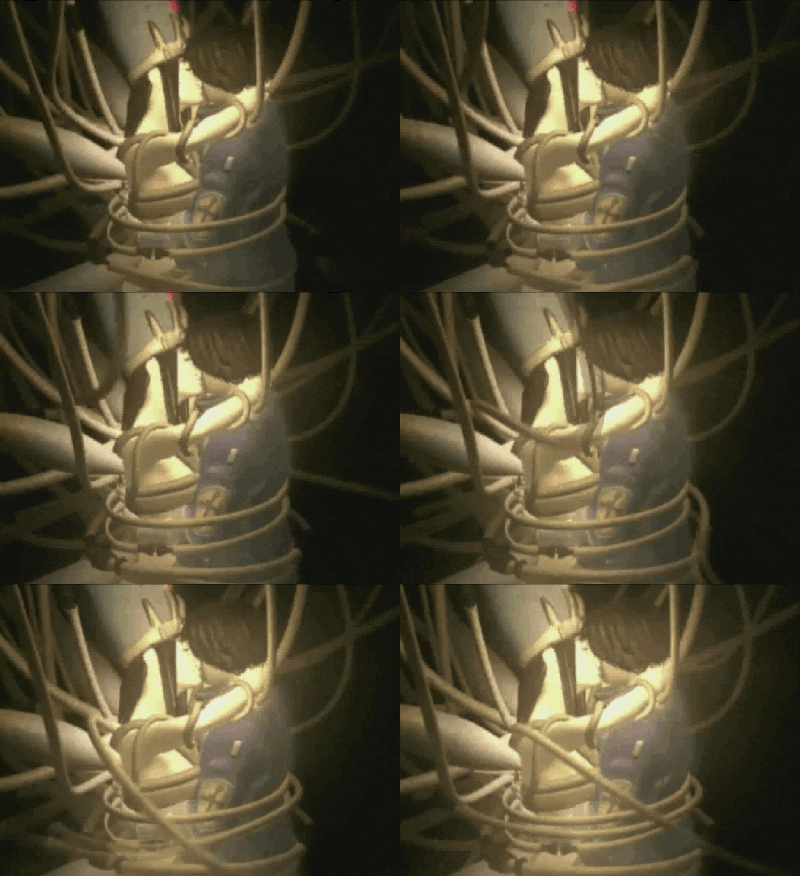
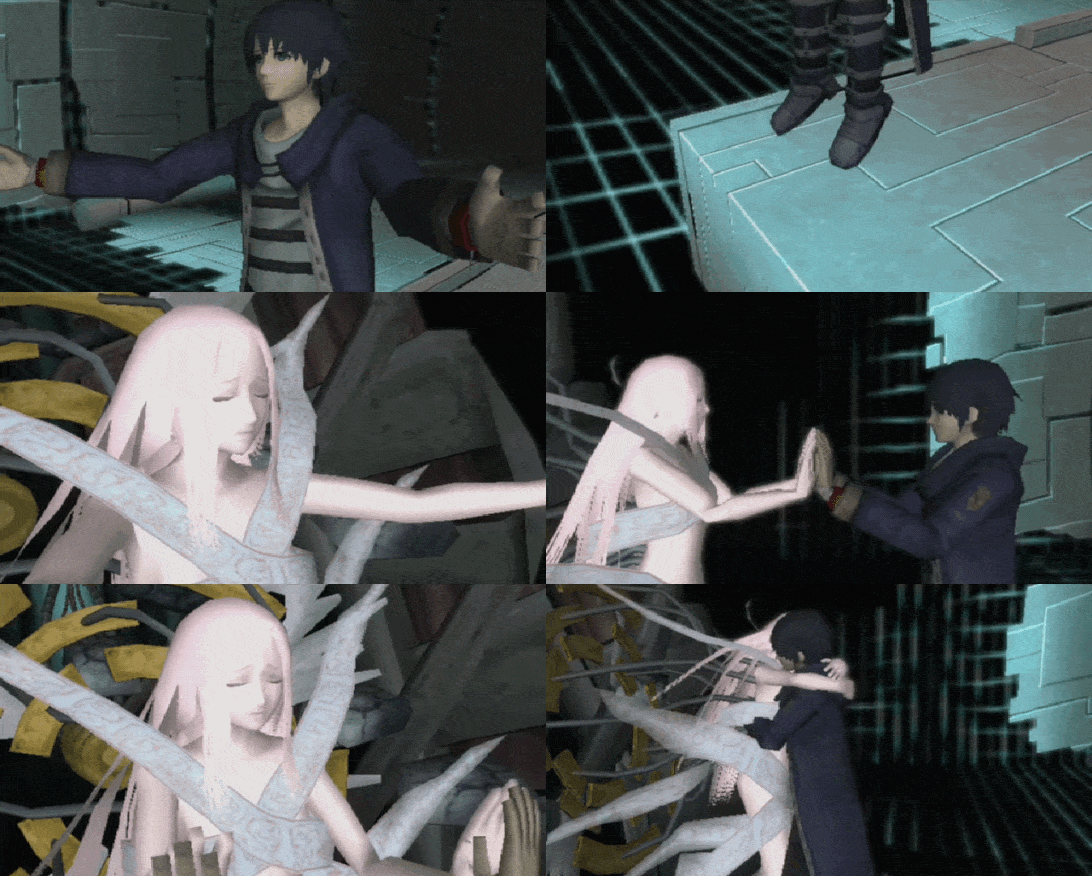
Following in the footsteps of the PS1 port, there are now more checklists and Hell Dungeons, although it may be more accurate to say there is only one Hell Dungeon with seven different rulesets. These variations each impose a restriction to the gameplay (such as ‘no flesh will appear’ or ‘taking in items with you is not allowed’). While the PS1 Hell Dungeon was able to be conquered from scratch, most of these runs will require heavy farming to prepare for. As for checklists, the Item and Scene lists return, as well as a brand new “Character List” and “Baroque List” - the latter of which functions as a sort of achievement system which provides a brand new way to permanently upgrade the parameters of the player character. Some of these ‘achievements’ will happen organically, but the majority will not. These require absurd, completely unintuitive actions like ‘upon starting, stand still until you die’, ‘consecutively swing your sword without hitting anything 500 times (mercifully reduced to 100 in the Atlus release)’, ‘have 15 different variations of a certain item type in your inventory when you die’, etc, etc. Locking this new upgrade mechanic behind such esoteric, unnatural prerequisites feels like a move made purely to sell strategy guides.
The Switch Port
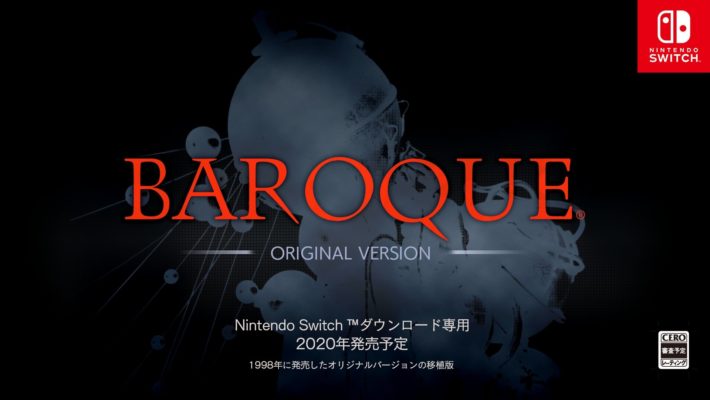
Fortunately, Sting completely and unexpectedly reversed course on November 12th, 2020 when the company released a faithful port of the original Saturn version for the Nintendo Switch. This is a nearly perfect port, with only some control stiffness and occasional audio glitching. However, the lag that cropped up on the Sega Saturn during hectic fights has been removed as the game is now running on next gen hardware. This port also includes several extras, including the Baroque Report CD Data File for the Sega Saturn. As long as you're willing to put up with the sub-par controls, this is currently the best and most accurate way to experience the definitive version of Baroque unless you have the cash to drop on a Saturn, 3D Control Pad, and a CRT.